







Why this travel icon still trades like a blue chip in 2025
Step off a red-eye, nudge the crown, and your local hour jumps forward while home time stays locked in place. That tiny, precise click is the everyday magic that keeps the Rolex GMT-Master II at the center of so many collections. In late 2025, core steel references still change hands on the open market at 40%–75% above list, even after a multi-year market correction. For a modern buyer, that means you are paying for a mix of usability, long history, and a track record of liquidity rather than hype alone.

From Pan Am cockpit to modern portfolio anchor
The GMT-Master story starts with jet age logistics, not Instagram. In 1955, Pan American World Airways asked Rolex for a tool that would let its crews see home time and local time at a glance across newly opened long-haul routes. The result was the first GMT-Master, reference 6542, with its now-famous two-tone “Pepsi” bezel, designed to distinguish day and night over 24 hours.
Early GMT-Master models linked the 12-hour hand and the 24-hour hand, so any time-zone change meant resetting the entire watch. In 1982, Rolex quietly solved that problem with the GMT-Master II and its independently adjustable local hour hand, creating what enthusiasts now call a “true GMT”. The wearer could jump the local hour forward or back in one-hour clicks without stopping the movement or disturbing the 24-hour reference time. That single functional shift remains one of the main reasons current buyers still see the line as more than just a colored bezel.
From there, the modern package took shape: sapphire crystals, improved oyster cases, new movements, and, from the mid-2000s onward, ceramic bezels that resist fading and scratches. The current Caliber 3285 brings a 70-hour power reserve, modern anti-magnetic components, and COSC plus Rolex internal chronometer testing. Add in quick micro-adjustments via Easylink on the bracelet, and you have a watch that can live on the wrist all week without begging for special treatment.
Choosing a bezel is choosing a personality, not a different engine
Under the dial, modern GMT-Master II references all share the same movement, water resistance, and core functionality. What you really choose in 2025 is the story you want to wear on your wrist and show in photos.
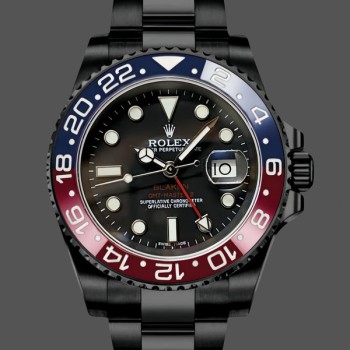
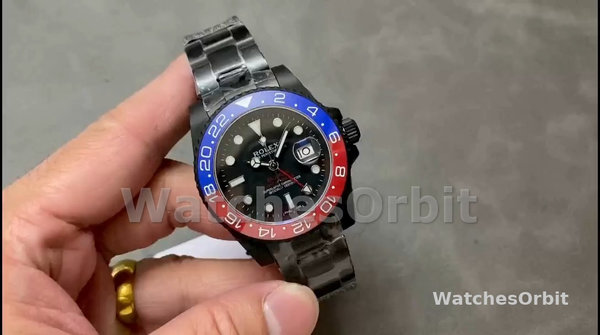
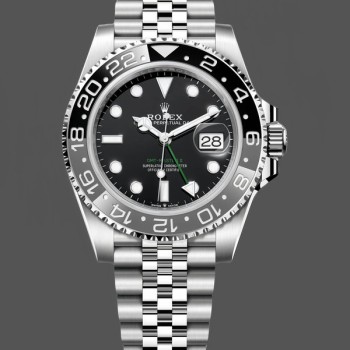
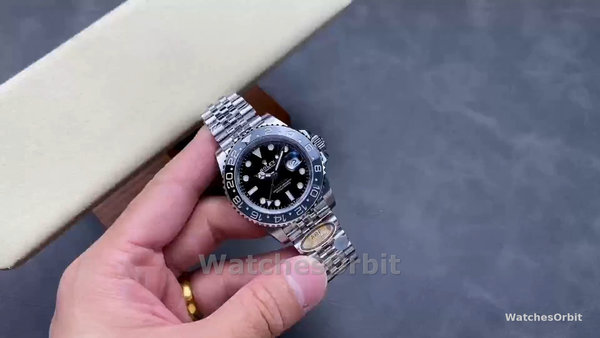
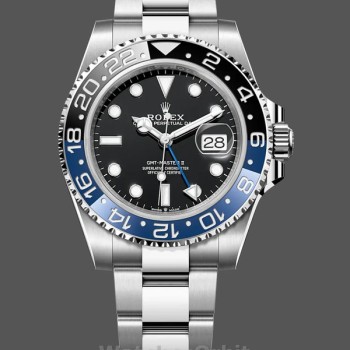
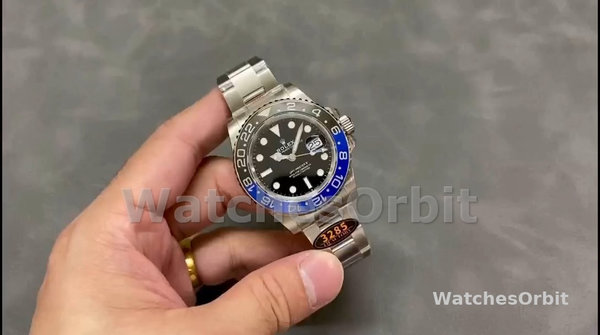
Pepsi (126710BLRO) carries the clearest link to that Pan Am origin story. It broadcasts “classic travel watch” louder than any other variant and remains one of the most recognizable bezels on the market. Batman/BLNR (126710BLNR) tones down that nostalgia with blue-black, splitting the difference between sportiness and discretion. The more recent grey-black “Bruce Wayne” (126710GRNR) plays up stealth with a monochrome look that disappears under a cuff but tends to photograph extremely well.
The left-hand Sprite (126720VTNR) adds an asymmetric twist: crown and date on the other side, green-black bezel, and a layout that favors right-wrist wearers. Rolesor Root Beer (126711CHNR) and full yellow-gold 126718GRNR bring warmth and visual weight, appealing to buyers who want presence first and spreadsheet gains second. All of them keep the same jump-hour functionality, 100-meter water resistance, and everyday practicality; the difference lies in how loudly each version announces itself in your feed and how wide the resale audience is when you eventually move it on.
What people are actually paying in late 2025
In theory, retail prices move in calm, annual steps. In the real world, secondary prices jump, sag, and slowly settle. The table below uses late-2025 snapshots to show where spreads actually sit between MSRP and real-world market levels.

| Model (ref.) | Retail (Oct 2025, USD) | Est. Market (Nov 2025, USD) | Premium vs retail |
|---|---|---|---|
| Pepsi 126710BLRO | 11,100 | 19,496 | +75.6% |
| Batman / BLNR 126710BLNR | 11,100 | 16,316 | +47.0% |
| Bruce Wayne 126710GRNR | 11,100 | 19,326 | +74.1% |
| Sprite 126720VTNR (LH) | 11,650 | 16,353 | +40.4% |
| Root Beer 126711CHNR (Rolesor) | 18,150 | 18,085 | −0.4% |
| Yellow Gold 126718GRNR | 44,600 | 41,969 | −5.9% |
SOURCE: WatchCharts — Rolex GMT-Master Prices as of 2025 (2025).
Steel pieces still command double-digit to high double-digit premiums, whereas two-tone and full-gold references cluster closer to list or even slightly below. For a buyer, that means steel remains the easiest to exit, but gold can quietly offer better value if you plan to keep the watch for many years and care more about metal weight than upside.

Where the GMT-Master II sits in the broader Rolex market
A large 15-year dataset compiled from real secondary-market sales shows just how far Rolex as a whole has come. Average transaction prices rose by more than 550%, from roughly 2,000 USD in 2010 to around 13,426 USD in 2025. Within that, the GMT-Master II category climbed from about 3,400 USD to roughly 20,595 USD, peaking near 23,992 USD in late 2021 before settling to current levels around 14% below that high.
That path mirrored the wider steel-sports boom: a long, steady build-up in the 2010s, a sharp escalation during 2020–2022, then a two-stage correction through 2022 and 2023. By mid-2025, spreads had compressed, but prices remained many multiples above 2010 baselines. For GMT buyers, the message is simple: this is no longer a lottery ticket, but it is still blue-chip territory if you buy with a realistic holding period in mind.
To put the collection in context, consider how three key Rolex pillars evolved on the secondary market:
| Collection | Avg price 2010 (USD) | Peak 2021–22 (USD) | Mid-2025 avg price (USD) | Distance from peak |
|---|---|---|---|---|
| Datejust | 1,150 | 9,926 | ~8,500 | About −14% |
| Submariner | 2,750 | 18,889 | 17,295 | About −8% |
| GMT-Master II | 3,400 | 23,992 | 20,595 | About −14% |
These figures show that GMT-Master II has appreciated more strongly than the average Rolex over the long run, yet it also absorbed a meaningful but manageable pullback after the peak. For someone coming in now, that translates into paying historically high prices without the same level of froth seen in 2021.
What the 2025 macro data is really saying
Zooming out from individual references, the broader secondary market has cooled from its 2022 fever without collapsing. In 2Q25, the WatchCharts Overall Market Index slipped just −0.3% quarter-on-quarter, while Rolex as a brand moved a hair less at −0.2%. At the same time, retail prices in the U.S. edged higher across several major brands, and the Rolex Certified Pre-Owned programme continued expanding its footprint at authorized retailers, adding thousands of verified listings to the “visible” supply.
| Indicator | 2Q25 reading | Why it matters |
|---|---|---|
| Overall secondary index (QoQ) | −0.3% | Declines are slowing; easier to gauge risk. |
| Rolex secondary (QoQ) | −0.2% | Blue-chip resilience near flat. |
| Retail lists (U.S.) | Up across brands | Could compress premiums in some metals. |
| RCPO footprint | Thousands of active listings | Verified supply improves pricing accuracy. |
SOURCE: Morgan Stanley × WatchCharts 2Q25 (2025).
For you as a buyer, a nearly flat index and modest retail hikes mean two things. First, the odds of another parabolic spike in the short term are low. Second, pricing has become more transparent: between open-market platforms and certified pre-owned channels, outlier asks are easier to spot and ignore.

Returns without fairy dust: what a realistic GMT play looks like
If you buy a steel GMT-Master II at list in 2025, you are stepping straight into a 40%–75% gross spread before fees and taxes. That headline number is seductive, but it is not the whole story. Transaction fees, currency conversion, and the risk of short-term sentiment shifts can easily eat 10–20 percentage points of that margin if you are thinking in months rather than years.
Gold and two-tone GMTs tell a different story. Rolesor Root Beer has hovered almost exactly at retail, while full yellow gold currently trades a few percent below list. Viewed as “investments”, they look dull. Viewed as long-term ownership pieces with higher intrinsic metal value and narrower future downside, they are less fragile than their premium profile suggests.
Over a 5- to 10-year horizon, three practical drivers matter more than any price chart:
- Liquidity: Steel models with recognizable nicknames—Pepsi, Batman, Bruce Wayne, Sprite—attract global demand and move quickly if priced in line with comparable sales.
- Standardization: The modern GMT-Master II family shares movements, case architecture, and servicing procedures, which makes maintenance costs more predictable than in many vintage or niche references.
- Wearability: A 40-mm sports case, 100-meter water resistance, and dual-time function mean you can actually wear the watch in the situations you travel and work in. Pieces that live on wrists, rather than in safes, tend to hold a solid baseline of value.
Features that quietly support long-term value
Beyond branding, the technical package does some heavy lifting for resale. The dual-time display is genuinely useful for anyone coordinating across time zones, not just frequent fliers. A bidirectional 24-hour bezel and a brightly colored GMT hand make reading a second time zone an instinctive gesture after a few days of wear. As articles dedicated to the model’s mechanics point out, the ability to track even a third time zone by rotating the bezel is not a party trick; it is a differentiator in a market full of one-time-zone divers and chronographs.
Ceramic bezel inserts avoid the fading, cracking, and chipping that plagued early Bakelite parts. The 70-hour power reserve means you can take the watch off Friday evening and still find it running on Monday morning. Micro-adjustments in the clasp allow the bracelet to cope with heat, flights, and long desk days without stretching or discomfort. None of these details show up in a price chart, but they collectively explain why the line has become a “default” modern Rolex for many collectors.

Who should be buying GMT-Master II in 2025—and why

- First-time luxury buyers: If you want one watch that can handle office, travel, and evenings out, a steel Pepsi or Batman offers instant recognizability, strong liquidity, and a clear exit market if your tastes change.
- Steady builders: Collectors with an existing core of dress and dive watches often add a GMT-Master II as their travel or “desk pilot” piece. Steel can play the growth role; two-tone or gold can be the stable, enjoyment-first holding.
- Condition purists: Full sets with crisp lugs, clean bezels, and original finishing still command a premium and sell fastest. In the current flatter market, condition can move the needle more than bezel color.
- Frequent travelers and remote workers: If you consistently juggle two or three time zones, the jump-hour hand and 24-hour scale will earn their keep every week. Left-hand Sprite models may add genuine comfort if you prefer wearing your watch on the right wrist.
A 2025 buying checklist you can actually follow this week
To turn all of this into a concrete plan, walk through a simple script before you transfer any funds.
- Define your role for the watch: daily wear, occasional travel, or long-term store of value. Your answer decides whether you prioritize steel liquidity, gold presence, or two-tone balance.
- Fix your acceptable spread: If you are paying over list, write down the exact percentage and check what similar pieces actually sold for in the last 60–90 days, not just what sellers are asking.
- Audit the set and condition: Prioritize full sets, recent service history, unpolished or lightly polished cases, and bezels without visible chips. Ask for high-resolution macro photos of the dial, crown guards, and end links.
- Watch timing and currency: Holiday seasons, regional demand spikes, and currency swings can open short windows where premiums compress. If you are buying from overseas, a favorable FX rate can be worth more than haggling over a few hundred dollars.
- Plan the exit before the entry: Decide in advance whether your likely exit channel is a dealer, a consignment platform, or a private sale. Each has different fees, timeframes, and documentation standards.
Why the history still drives today’s prices
One reason the GMT-Master II has stayed relevant is that its backstory keeps expanding. From the original Pan Am bakelite-bezel 6542 to the long-running 1675, to aluminum-insert Coke and Pepsi bezels, to modern ceramic Batman and Sprite variants, the line has rarely stood still for long. Each generation introduced new sizes, movements, and materials while preserving the core idea: one watch that lets you read the world at a glance.
Collectors also respond to “chapters” in the series—nipple-dial gold 6542s, matte-dial 1675s with tritium, early sapphire-crystal pieces, and the first Cerachrom bezels—because they offer historically bounded stories and finite production runs. Even if you are buying only modern references, that decades-long narrative underpins why demand has proven so durable through booms and corrections.

Alternatives if you want the function without paying the full crown premium
Not everyone needs or wants the specific mix of brand pull and pricing that the GMT-Master II commands. If you care primarily about the complication, several alternatives deliver similar or even broader functionality at lower entry points.
Tudor Black Bay GMT brings a familiar design language, in-house movement, and strong tool-watch credentials at a fraction of the cost, while still sitting under the same corporate umbrella. Omega’s Seamaster Planet Ocean GMT offers more water resistance and a more overtly technical look. Grand Seiko’s Spring Drive GMT models add high-end finishing and the unique smooth-gliding seconds hand. Breitling’s Chronomat GMT 40 gives you a modern, travel-ready aesthetic with easier availability. Even inside Rolex, the Explorer II offers a fixed-bezel GMT option that flies lower on the radar but delivers almost the same functionality on the wrist.
One more lens: enjoyment first, spreadsheet second
The final choice often comes down to how you balance enjoyment and numbers. Steel GMT-Master II references draw the widest audience and historically strongest spreads, making them the natural choice for buyers who want flexibility. Precious-metal variants trade some of that liquidity for wearing pleasure and tangible metal value.
If you approach the watch as a long-term travel companion with strong residual value, rather than a short-term trade, the 2025 market is unusually forgiving. Prices are off their peaks, data is more transparent than ever, and the model’s core purpose—and the way it fits into modern global working life—remains as relevant as it was in the Pan Am era.

FAQ:
Q: Is the Rolex GMT-Master II still a smart buy in 2025 if I am late to the party?
A: For steel references at or near retail, the answer is generally yes. Long-term data shows prices are far above 2010 levels but below 2021–2022 peaks, so you are no longer buying at the very top of the cycle, and liquidity for core bezel variants remains strong.
Q: Which GMT-Master II models are currently the most liquid?
A: Steel BLRO (Pepsi), BLNR (Batman), and GRNR (Bruce Wayne) usually sell fastest because they combine iconic colorways with broad global recognition. Clean, full-set examples of these references tend to move quickly when priced close to recent realized sales rather than ambitious listings.
Q: How should I think about holding period and expected returns?
A: The GMT-Master II has already delivered a 5- to 6-fold average price increase since 2010, so expecting another similar jump in a few years is unrealistic. If you plan to hold for 5–10 years, focus on buying the right reference, condition, and price spread now, and treat any additional appreciation as a bonus rather than a promise.
Q: I travel often—should I choose a Sprite, Batman, or another version?
A: Start with ergonomics and readability. Sprite works well for right-wrist wearers thanks to its left-side crown; Batman and Pepsi offer classic looks and proven liquidity. Check which bezel colors you actually enjoy reading in low light and over long days, then weigh market premiums second.
Q: Are gold GMT-Master II models bad investments compared with steel?
A: They are not bad; they simply serve a different purpose. Full-gold references can sit slightly below retail on the secondary market, but they offer high wearing pleasure and relatively limited downside if you intend to keep them for many years. Think of them as long-term enjoyment pieces with a solid floor, rather than as leverage for maximum percentage gains.
References:
(WatchCharts — Rolex GMT-Master Prices as of 2025|2025|https://watchcharts.com/watches/brand/rolex/gmt-master)
(Morgan Stanley × WatchCharts 2Q 2025 Watch Market Report|2025|https://quillandpad.com/wp-content/uploads/2025/07/WatchCharts-MS-2Q25-Watch-Market-Report.pdf)
Author
By: Alex Carter — watch-market analyst and former secondary-market buyer. He combines pricing data with hands-on sourcing insights to help readers buy confidently and sell strategically. Learn more at WatchesOrbit.
Related Products